First: when to keep Monday.com
Let's start where most comparison pages won't. If your process is close to generic project tracking — tasks, owners, due dates, a handful of automations — Monday.com is excellent. Setup is instant, the template ecosystem is huge, and nothing we build competes with "working this afternoon on a subscription." Plenty of owner-run companies should stay right there, and if that's you, this page just saved you $15,000.
The calculation changes when three things line up: the workflow you're forcing into the tool is the thing that makes your company different; the per-seat bill compounds as the team grows; and spreadsheets, exports and chat threads have started orbiting the tool to cover what it can't model. That was us.
Where it started to hurt
Our media company ran its production on Monday.com — episodes moving through recording, editing, mixing and delivery. The tool held the cards; it just couldn't hold the process:
- The board couldn't enforce our rules. A generic status column doesn't know that an episode can't enter mixing before its audio is delivered — so people had to know it, remember it, and catch each other's misses.
- The real state lived elsewhere. Three spreadsheets and a WhatsApp group grew around the board — resourcing here, delivery tracking there, "did it ship?" answered by scrolling chat.
- Every automation was an approximation. We were configuring workarounds to imitate our workflow instead of running it.
- The bill scaled with headcount, not with value. Every new hire was another seat, forever — for a tool that modeled less and less of how we actually worked.
If that list reads like your own operation with the names changed, the underlying pattern is the one we wrote up in the outgrown-spreadsheets guide — a generic tool plus the sheets orbiting it, quietly becoming the system your company runs on.
What we built instead
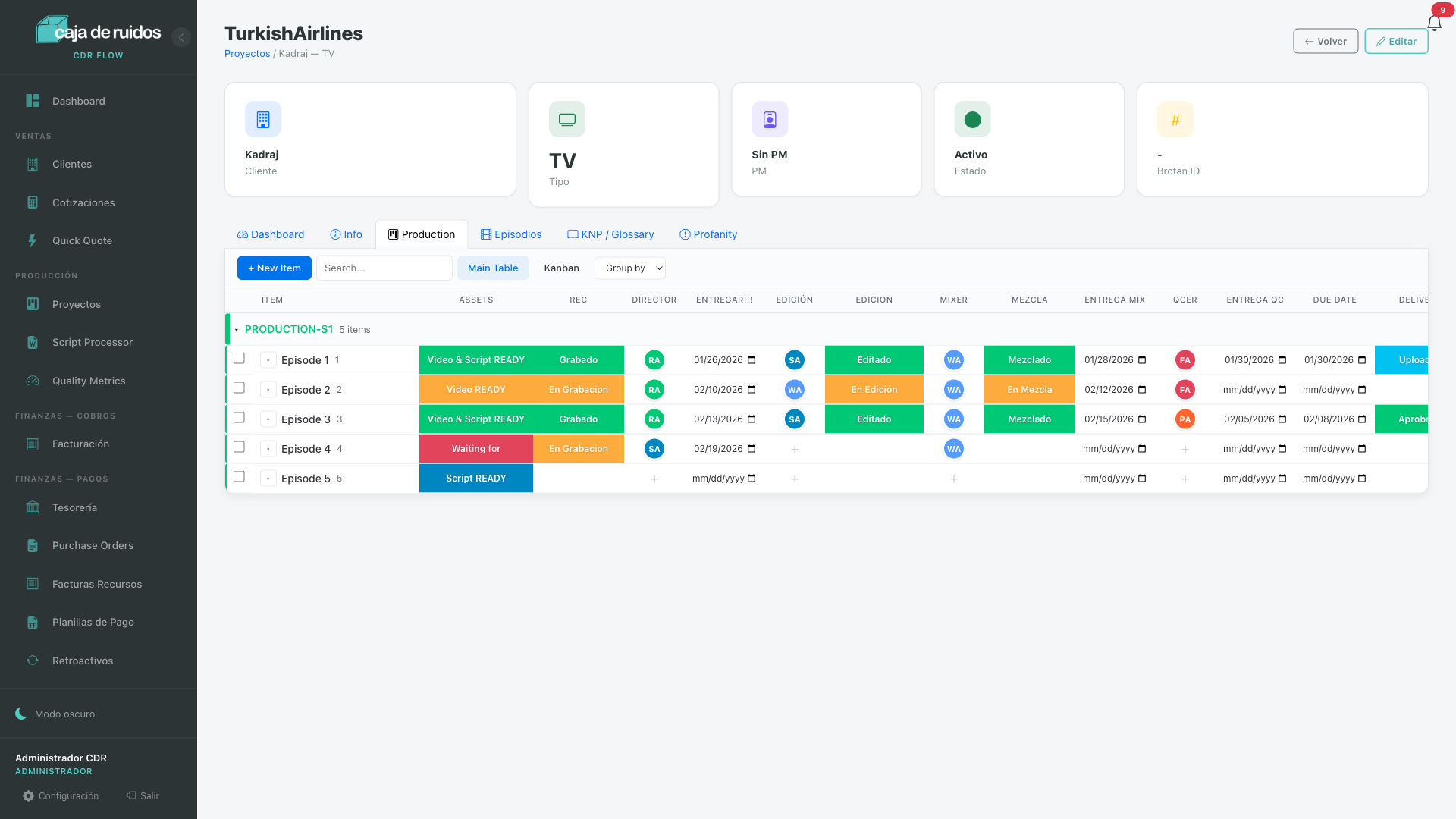
CDR Flow is the production board that replaced the subscription, the three spreadsheets and the WhatsApp group. Same board metaphor — episodes as cards, stages as columns — but the process is the code:
- Board and sub-item model shaped to production — episodes, their tasks, their dependencies, as first-class things instead of generic rows.
- Dependencies and assignments with traceability — the board knows what blocks what, and who's on it.
- Operational views for production leads — capacity and status without exports.
- One source of truth — the spreadsheets and the chat thread didn't get integrated; they got unnecessary.
The math
Software spend removed when the subscription and its orbit of tools went away — $60,000+ over three years, and counting.
The board is owned, not rented. Headcount grows; the software bill doesn't.
Against that: a build that starts at $15,000, owned outright, entered through a $3,500 first system in 48 hours. The crossover math is the same one we drew in the cost guide — and if your numbers don't clear it, our published rule applies: if the math doesn't work, we shouldn't build it.