Communication · distributed teams

Schedule WhatsApp Messages in the Recipient's Time Zone

Write at 11 PM in Los Angeles; it arrives at 9 AM in Buenos Aires. Timezone worked out from the phone number, weekends and holidays respected.

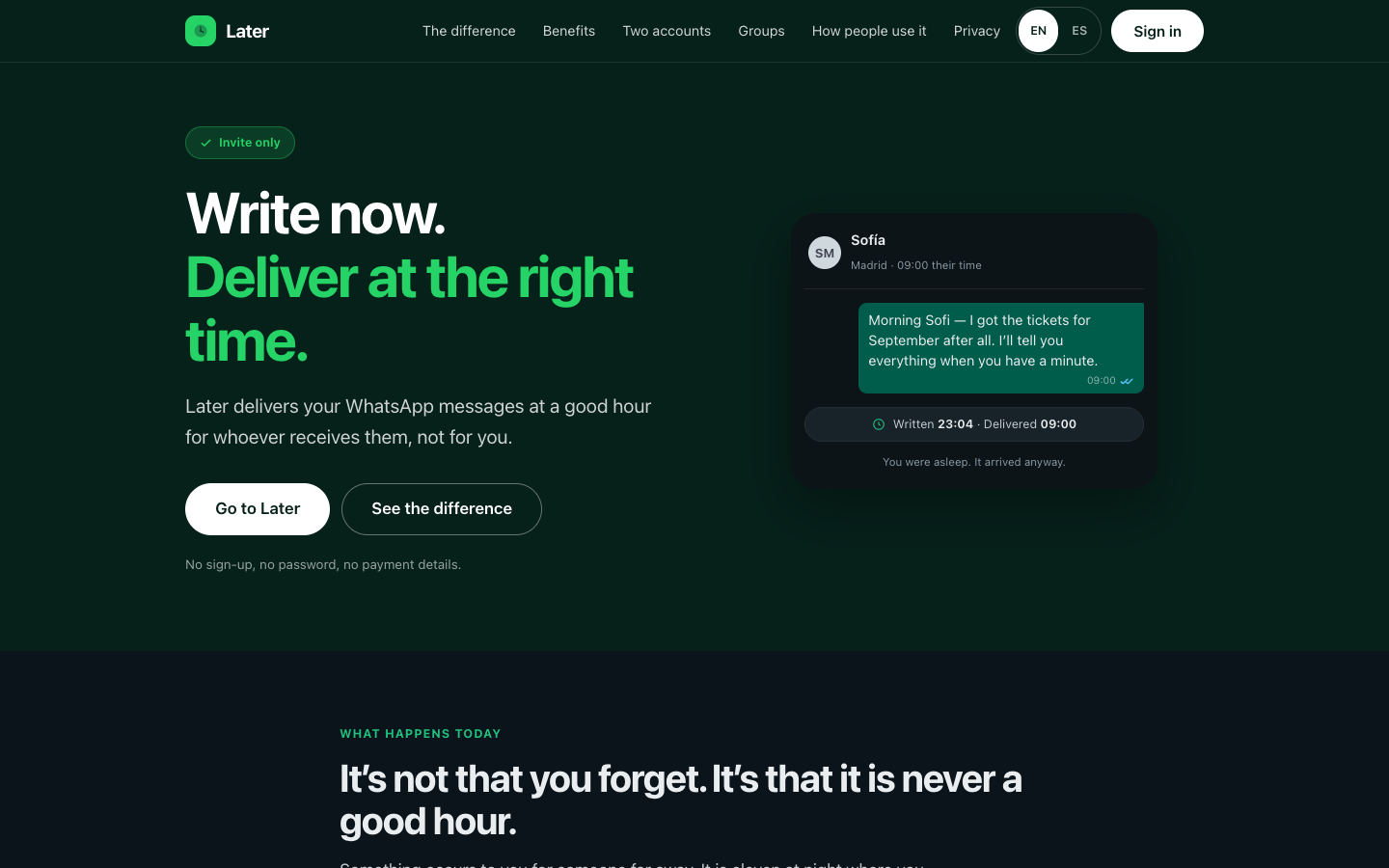
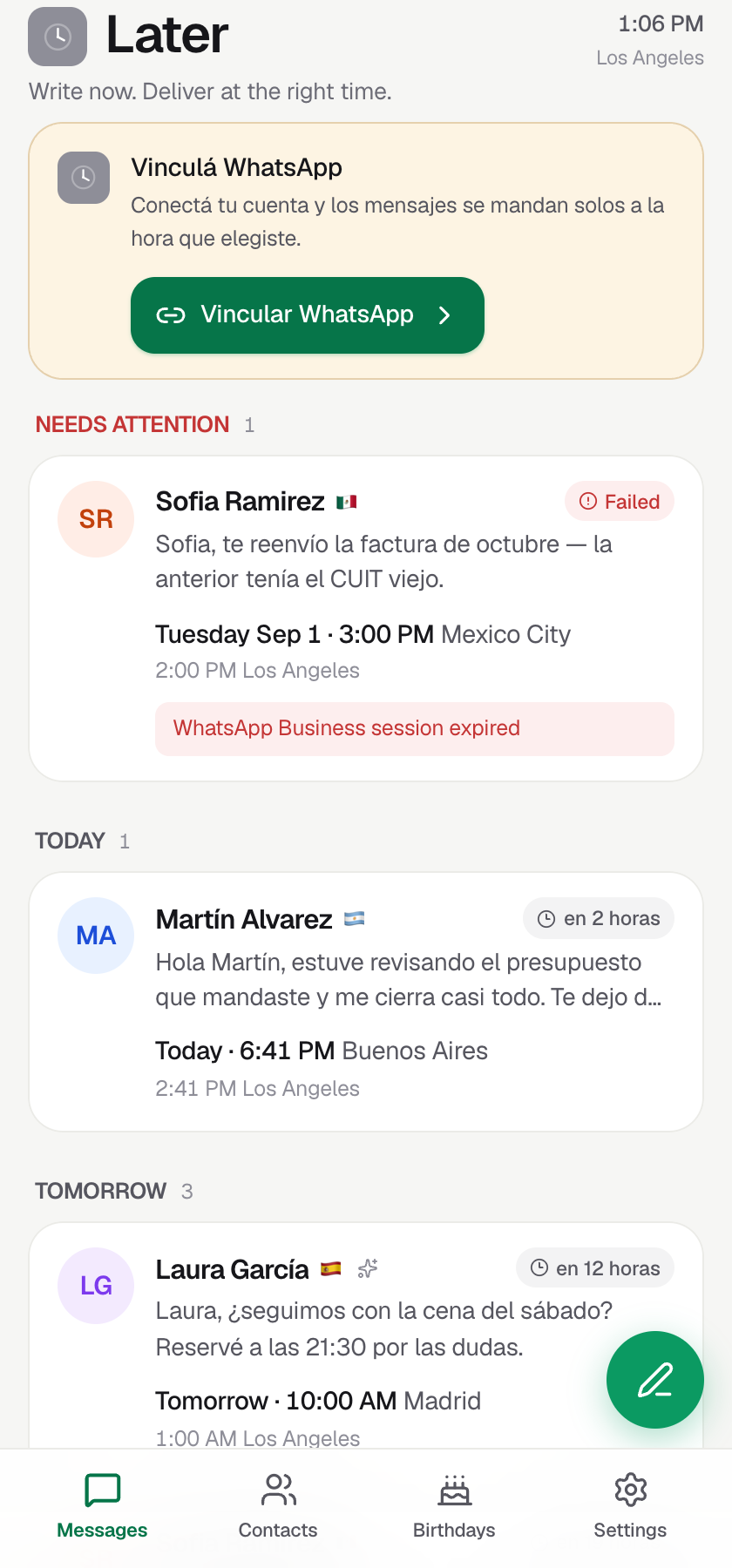
Later: write now, deliver at the right time — a WhatsApp message written at 23:04 and delivered at 09:00 in the recipient's timezone Later queue on a phone: messages grouped by Needs attention, Today and Tomorrow, each showing the recipient's local delivery time and yours

Real product — the landing and the message queue running on a phone. Contacts and messages are demo data.

Communication · distributed teams

Later — Deliver at the Right Time

Written at 11 PM, read at 9 AM their time

Problem
When your team, clients and suppliers live across time zones, the moment you think of a message is almost never a good moment to send it. It's 11 PM in Los Angeles and 4 AM in Buenos Aires — so you leave it for later, and later never comes. Or you send it anyway and someone's phone rings in the middle of the night. It's not a memory problem; it's a timing problem.
What we built
A phone app that holds your WhatsApp message until it's a civilized hour where the other person actually is. It works out the recipient's timezone from their phone number, proposes a calm morning arrival that skips their weekends and public holidays, and always shows both clocks — theirs as the headline, yours as the footnote. Understands "mañana a primera hora" or "Monday morning". Sends on its own through your linked WhatsApp, even with your phone off, and tells you if a delivery fails instead of losing it silently. Work contacts get office hours; friends and family don't. Birthdays repeat every year without touching them again.
What changed
The message gets written when you think of it and delivered when it should be read. Nobody does timezone arithmetic, nobody gets woken up, and nothing that mattered stays stuck in the "later" pile. Both your personal and business WhatsApp run from the same app, each with its own queue and rules.

Client Zero: built because our own team spans Los Angeles and Buenos Aires.
What the system does

  • The recipient's local time is the headline on every screen; yours is the footnote
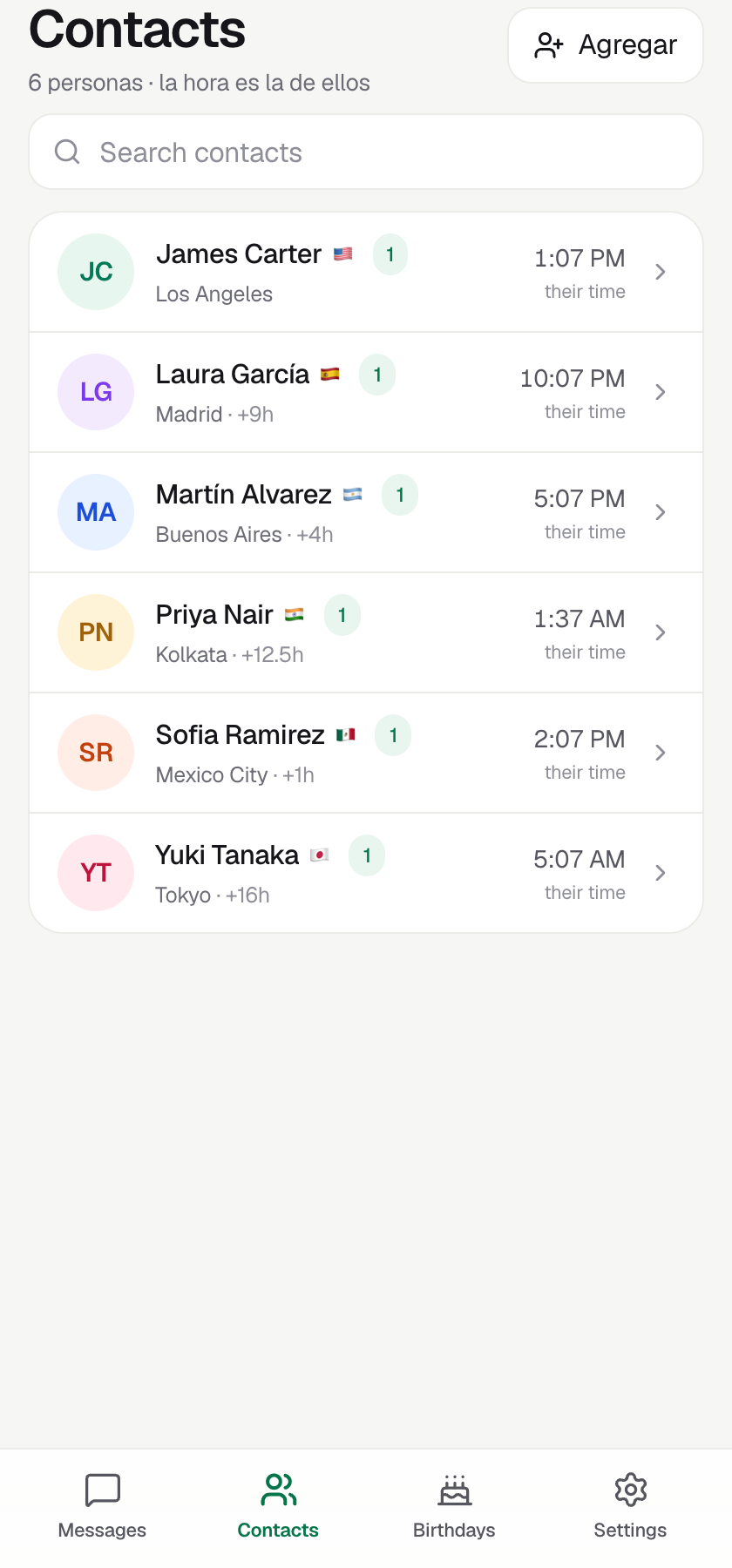
  • Country and timezone worked out from the phone number — down to telling Los Angeles from New York on +1 numbers
  • Smart Time proposes the first calm morning slot that clears their hours, your rules, weekends and their country's holidays — and says why in one line
  • Understands “Monday morning”, “lunes 10am”, “esta tarde”, “in 2 hours” — and shows its interpretation before you commit
  • The queue groups by Needs attention / Today / Tomorrow / This Week / Later, with swipe to edit, send now or cancel
  • Per-contact preferred hours, weekdays and weekends separately — plus a live local clock for every contact
  • Global guards: business vs. personal hours, never-before and never-after limits, weekend and holiday avoidance
  • Link a WhatsApp account by QR and messages send themselves — even with your phone off
  • A status heartbeat shows delivery health at a glance; with nothing linked, a notification opens WhatsApp with the message pre-written — one tap from Send
  • Birthdays repeat every year: a private reminder for you, or an automatic greeting in their morning
  • Personal and business accounts side by side, each with its own queue and rules
  • Full English/Spanish interface — and message bodies are wiped an hour after delivery

By the numbers

  • Written at 11 PM in Los Angeles, read at 9 AM in Buenos Aires
  • Deliveries paced like a human: a few messages per pass, irregular gaps, a 40-message daily cap
  • Message bodies deleted one hour after delivery
  • Two accounts per phone, each with its own rules
  • “Clients in other time zones stay happy — without it depending on my family life.” — the owner, Client Zero

Does this look like your bottleneck?

This system started as one specific problem in one real company. Tell us yours in a sentence — within 24 hours we'll tell you whether it's buildable and whether the math is likely to work.

Show us the problem →

See all 13 systems →